
 newsletter
 contact us
 donations
Chronicle of a Foretold Deadlock
Prologue – How Resolution 16 Came to Be
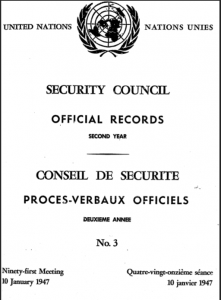
Original document: Official UN Security Council record of the meeting of 10 January 1947 (S/PV.91), in which the Council formally assumes international responsibility for the Free Territory of Trieste. This status has never been lawfully extinguished.
At the end of World War II, Europe was not only a destroyed continent: it was an open problem.
And at the heart of that problem stood Trieste.
In 1945, Winston Churchill still entertained an idea that today sounds like geopolitical science fiction, but at the time was anything but unrealistic: rebuilding a great Central European area capable of holding together the Danubian and Balkan peoples in a democratic confederation — a sort of Austro-Hungarian Empire 2.0, without an emperor but with shared institutions.
A geopolitical barrier between Germany and Russia, between Anglo-American capitalism and Soviet socialism.
It was a project that lasted only the span of a lucid dream.
Because between 1945 and 1946 Europe split into two opposing blocs, and with the Iron Curtain fell the last illusion of a truly common political architecture for Central Europe.
But the Great Powers did not entirely abandon the idea of preserving an economic pivot in the Adriatic.
If the Empire could not be rebuilt, at least its logistical heart could be saved: Trieste as an international port, the natural emporium of the Danubian and Balkan basin, the hinge between the Mediterranean and inland Europe.
It is against this background that diplomacy moved in 1946:
-
Spring–Summer 1946: the Council of Foreign Ministers (USA, USSR, UK, France) works on the Peace Treaty with Italy;
-
Autumn 1946: the solution of the Free Territory of Trieste takes shape, with its Statute, provisional regime, and international Free Port;
-
December 1946: the texts are transmitted to the UN. Formal legitimacy is required;
-
January 1947: the ball passes to the Security Council.
On 10 January 1947, the Security Council adopts Resolution 16: it does not create the Free Territory, but it does something perhaps even more decisive — it assumes responsibility for guaranteeing its integrity and independence.
And here the problem begins.
Not afterwards. Not by accident.
Here.
The Structural Flaw
There is an error weighing for more than seventy years, and no one has ever wanted to call it by its real name.
It is not a historical accident. It is not a diplomatic misunderstanding.
It is a structural flaw.
And its name is Security Council Resolution 16.
Because that resolution makes a choice elegant on paper and paralysing in reality: instead of placing the protection of the Free Territory of Trieste under the UN General Assembly — the only organ where the founding principle truly applies, one State, one vote — it delivers it to the Security Council.
That means: five powers with veto rights — the United States, the Soviet Union, the United Kingdom, France and China.
And among them, already in 1947, the two decisive superpowers — Washington and Moscow — were destined to block each other on everything, starting precisely with the appointment of the Governor.
Translated into non-diplomatic language: the fate of a neutral city-State was entrusted not to the international community, but to the permanent arm-wrestling of the superpowers.
Not to law.
To force.
It is like proclaiming neutrality and immediately handing it to those who, by definition, can only turn it into a battlefield.
A solution containing its own negation.
The Veto Trap
The proof is brutally simple: the Governor of the Free Territory of Trieste was never appointed.
Why?
Because the appointment required Security Council approval.
(The story of the never-appointed Governor is reconstructed here:
https://www.triest-ngo.org/it/3841/)
And inside the Security Council sat two powers that after 1947 were no longer allies but systemic enemies: the United States and the Soviet Union.
Every name became a battlefield.
Every candidacy an excuse for veto.
Every meeting a chess game where Trieste was nothing but a disposable pawn.
The result: a State created to be neutral is paralysed by the conflict between blocs.
An entity designed to overcome Cold War logic was trapped at birth inside that very logic.
This was not fate.
It was written into the institutional DNA of the project.
This Is Not a Thesis: Australia Said It in 1947
Here comes the part no one remembers today.
In the official verbatim record of the Security Council session (S/PV.91), Australia abstained on principle.
Its representative, N.J.O. Makin, declared that his government had identified real “constitutional difficulties”, contesting that the Security Council could, under the UN Charter, assume future legislative and administrative functions over a territory.
He concluded:
“my delegation abstains from voting.”
Final vote: 10 in favour, 0 against, 1 abstention: Australia.
The flaw was visible already that day.
The official UN record is available here:
https://digitallibrary.un.org/record/111973?ln=en
The UN Then and the UN Now
There is another detail often missed today, but decisive in 1947: the UN was then a young institution, taken deadly seriously, onto which a world just emerged from the abyss poured renewed hopes of rationality and peace.
Security Council resolutions were not conference paper: they were real geopolitical acts, taken seriously by the great powers.
Today, instead, the UN is perceived as a tired and useless circus, where everything is proclaimed and nothing is achieved.
And this makes the tragedy even clearer: Trieste was entrusted to a fragile mechanism already then — today almost unrecognisable.
Permanent Deadlock, Administrative No Man’s Land
When the mechanism jammed — and it jammed immediately — no one reversed course.
Time was allowed to pass.
The anomaly was normalised.
Everything was archived under the elegant formula: “reality of facts.”
But no one truly won.
Italy did not win.
Yugoslavia did not win.
Not even the West.
Only one thing won: deadlock.
Trieste never became a real State.
But it was never reintegrated into any authentic Italian-European design either.
It became a city in slow necrosis, kept alive through continuous overdoses of badly-cut post-Risorgimento nationalism: useful only for ceremonial speeches no one has believed for at least a quarter century — and lethal when it comes to building a future.
An administrative no man’s land in peacetime.
An eternal geopolitical sunset boulevard.
A City Without a Role Empties Out
Today this unfinished outcome is not only a legal or geopolitical problem.
It has become a demographic one.
Trieste, which should have been an international city, grew when it was the port of the Empire and survived when it was a frontier.
Since it became a periphery, it has begun to empty.
In recent decades the city has lost tens of thousands of inhabitants, with one of the highest ageingrates in Europe and a steady youth drain.
Not by natural destiny.
But because a city without a function holds no one.
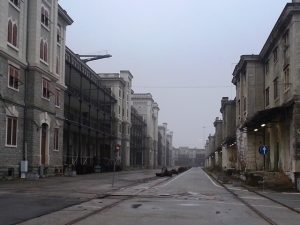
Porto Vecchio: Trieste’s visible necrosis. Stripped of its public status in December 2014 (Francesco Russo’s signature) and thrown into a grotesque urban redevelopment scheme, while its international port function — the Free Port regime and the obligations of the Free Territory of Trieste — was deliberately dismantled and quietly buried.
[ISTAT] data confirm that Trieste has now fallen below the psychological threshold of 200,000 residents, with a heavily negative natural balance: more funerals than births, more departures than returns.
A city that should have been an international emporium has become a demographic periphery, slowly losing its future.
A Port Alive Only on Life Support
The same applies to the port.
On paper, one of the great Adriatic hubs.
In reality, a port surviving on life support.
Remove SIOT crude oil, and the picture is bleak: weak commercial traffic, evaporated emporial function, Danubian role reduced to conference slogans.
Trieste should have been the natural terminal of Central Europe.
Instead, it has become a monothematic hub, dependent on a single supply chain and increasingly exposed to external strategic logics.
This is not rebirth.
It is managed survival.
Vyshinsky Said It — And He Was Right
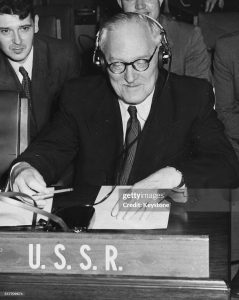
Andrei Vyshinsky at the UN Security Council (1953). The Trieste question was still officially unresolved — and the failure to appoint a Governor was already generating “new complications.” History did not close this file. Politics simply buried it.
In 1953 it was not a commentator but the Soviet representation at the UN.
On 12 October 1953, in an official letter to the Security Council regarding the Governor issue, Andrei Vyshinsky warned that
“the partition of the Free Territory of Trieste is incompatible with the task of maintaining peace and security and is destined only to create new complications.”
This was not propaganda.
It was political diagnosis.
Official UN document S/3105 (Vyshinsky letter to the Security Council, 12 October 1953) can be consulted in the Security Council Supplement (Oct–Dec 1953):
https://digitallibrary.un.org/record/605833/files/S_SUPP_1953_4–%5EOR_SC_1953_4%5E-EN.pdf
Yet Something Moves: Hungary in Trieste
And yet, something moves.
Not thanks to Rome.
Not thanks to Brussels.
But thanks to those who understood sooner than others that Trieste remains a geopolitical key.
Hungary’s acquisition of three and a half hectares of the former Aquila area in the industrial port is not a real-estate deal.
It is a political signal.
And it does not come from nowhere: it comes from the fact that someone outside Italy has read the documents and the international legal opinions far more carefully than those who should have done so first.
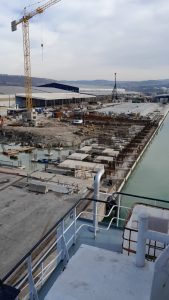
Koper/Capodistria works, expands, builds. Trieste, instead, has exhausted its vocation in an almost metaphysical suspension, until it has been reduced — today — to a tourist stage set of pizzerias and piadina joints, while its Free Port function is left to wither on paper.
Budapest is not acquiring square metres.
It is acquiring access to the sea.
Strategic projection.
A piece of that international function Trieste had lost.
Paradoxically, it is other States that are reminding Trieste of what Trieste was.
And what it could become again.
The Bill Always Comes Due
Let’s drop the fairy tale of “no one was watching.”
They were watching.
The last subjects with a direct UN mandate over Zone A and its International Free Port were not ghosts, not abstractions, not some vague “international community.”
They were the United States and the United Kingdom.
The guarantors.
The controllers.
So the real question is not why nobody controlled the controller.
The real question is much simpler — and much uglier:
Who controls the guarantors when the guarantors decide the guarantee is no longer convenient?
Because this is exactly what happened after 1954.
The Free Territory of Trieste was not “forgotten.”
It was shelved.
The Governor was never appointed.
The Statute was never activated.
The international regime was quietly euthanised.
Not by accident.
Not because the UN was distracted.
But because the great powers who were supposed to enforce the legal framework decided that enforcing it was no longer useful.
A genuinely neutral Trieste, outside NATO, outside direct control, with an international port and its own statute, was no longer an asset.
It was a risk.
So the solution became the oldest one in geopolitics:
Proclaim the law.
Sabotage the law.
Declare the sabotage irreversible.
Call it “reality.”
Italy did not solve Trieste.
Italy was simply allowed to occupy the vacuum left by Anglo-American withdrawal from responsibility.
A subcontracted administration, dressed up as sovereignty.
And the UN did what it does best when power speaks:
It stayed silent.
It looked away.
It let the “temporary” become permanent.
This was not international order.
It was organised hypocrisy.
Because when the rule of law depends on the veto and convenience of empires, you do not get peace.
You get deadlock.
You get impunity.
You get Trieste: a legal anomaly frozen for seventy years, waiting for the day someone decides to unfreeze it — not out of justice, but out of interest.
And interest, as always, is the only thing that never expires.
Alessandro Gombač
Founder and first President of the Free Trieste Movement
This question was buried, not resolved.
And buried things have a habit of resurfacing.