
 newsletter
 contact us
 donations
The Danube corridor, the Free Port and the return of Trieste to the center of European geography
Hungary and Slovakia are investing in Trieste to secure their access to the Adriatic and the Danube corridor.
The development is quietly restoring the historic role assigned to Trieste by the 1947 Peace Treaty: the maritime gateway of Central Europe.
There is one thing in Trieste that almost no one says out loud.
The Hungarian investment in the port was not made for Italy.
It was not made for the Italian market.
And certainly not to “develop Trieste”, as press conferences and official statements claim with the Italian tricolour in the background.
It was made for the Danube.
For Budapest, Trieste is not an Italian port.
It is the natural maritime gateway of Central Europe.
Exactly the function assigned to it by the Peace Treaty of 10 February 1947.
A function that Italy has ignored — or more often suffocated — for more than seventy years.
Now someone has decided to use it.
And paradoxically, it may be precisely this foreign investment that will bring back to Trieste something the city has been missing for a long time: real commercial traffic.
Today the port often appears almost desolately empty, apart from the constant movement of the usual oil tankers.
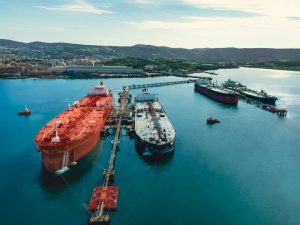
Oil tankers at the Trieste Oil Terminal (TAL), one of the main energy corridors supplying Central Europe through pipelines to Austria, Germany and the Czech Republic.
When the Danube corridor begins to function again in practice, Trieste will once more see ships, cargo and work.
Not just concrete and dredging, but port activity, logistics and employment.
A real economic impact for the people of Trieste — and for the entire Central European hinterland.
The paradox is that it will probably be Hungary that sets this historic function of the port of Trieste back in motion.
What Hungary is really doing in Trieste
Budapest has created Adria Port Zrt, a state-owned company tasked with building a logistics terminal on the 32 hectares of the former Aquila area (Aquilinia–Noghere).
The numbers are straightforward:
-
concession: 60 years
-
investment: over €200 million
-
expected operations: 2028
This is not a commercial participation.
It is a Hungarian national infrastructure located outside Hungarian territory.
A kind of logistical embassy on the Adriatic.
Except that instead of diplomats there will be:
-
railway tracks
-
cranes
-
freight trains.
The core of the operation
The decisive element is not the docks.
It is the railway.
The agreement with GYSEV Cargo aims to create a direct connection between Trieste, Hungary and the Danube basin. This means dedicated rail slots, logistical flow planning and integration with the Central European hinterland.
At the same time Budapest is linking itself to the network that actually moves goods across the heart of the continent — the one built over the years by operators such as METRANS and HHLA.
Not surprisingly, HHLA is already present in Trieste with the logistics platform HHLA PLT Italy, one of the intermodal hubs connecting the port to the Central European railway network.
In other words, this is not about building a network from scratch.
It is about entering a logistics system that already links Trieste with the industrial core of Central Europe.
Whoever controls the intermodal railway controls the traffic.
The port is only the door.
The house lies further north, along the Danube.
Why Trieste
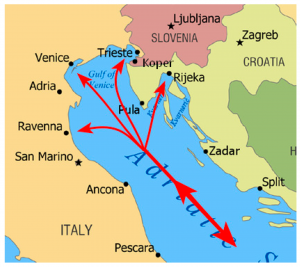
Port of Koper (Capodistria), Slovenia. Despite lacking the International Free Port status granted to Trieste in 1947, the port has become one of the fastest-growing logistics hubs in the northern Adriatic.
The choice has nothing romantic about it.
It is strategy.
Hungary is a landlocked state.
Depending on Hamburg, Rotterdam, or on a single Adriatic port means geopolitical vulnerability.
Having its own terminal means direct access to the Mediterranean.
And above all control over the logistics chain: terminal, trains and operators.
This is not free market dynamics.
It is national economic policy.
To understand why Budapest is looking at Trieste, one only needs to look at a map.
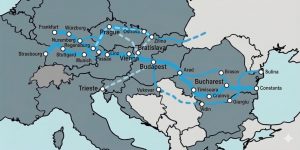
The Danube corridor linking Central Europe to the Adriatic: the strategic route that makes Trieste the natural maritime outlet of the Danube basin.
The Slovak factor: the emerging Central European push
Hungary is not the only Central European country looking at Trieste.
Another landlocked state is moving in the same direction: Slovakia.
Recent developments in 2024–2025 suggest that Bratislava is no longer acting merely as a passive user of the port, but is increasingly interested in securing a direct logistical presence in Trieste.
A key signal came in May 2025, when Slovak President Peter Pellegrini paid an official visit to the port of Trieste. The visit was not simply ceremonial. It reflected a strategic view widely shared in Bratislava: Trieste is seen as Slovakia’s most natural maritime outlet.
Logistics figures confirm this shift. For 2025, Slovak operators have set the objective of exceeding 500 direct freight trains between Trieste and Slovak inland terminals such as Dunajská Streda and Bratislava, potentially tripling traffic levels compared with only a few years ago.
The Slovak strategy is closely linked to the Hungarian initiative. The planned logistics terminal in the former Aquila area could serve not only Hungarian exports but also Slovak industrial supply chains, particularly in the automotive sector.
In practice, Hungary and Slovakia are increasingly acting as a Central European logistics bloc.
For both countries, the legal framework of the Free Port established by Annex VIII of the 1947 Peace Treaty is not an abstract legal debate but a practical necessity.
As noted in the Grant–Verdirame legal opinion (paragraph 92), the Free Port of Trieste was designed precisely to meet “the needs of the countries of Central Europe.”
If a landlocked state such as Slovakia were to formally invoke its rights as a user state of the Free Port regime, the issue could no longer be dismissed as a purely internal Italian matter.
The geopolitical implication is clear.
Trieste is gradually returning to the role it historically played:
the maritime outlet of the Central European hinterland.
Trieste: a peculiar legal zone
Today Trieste is administered by Italy and lies within the European Union.
But its international legal framework remains unusual.
An official communication of the European Commission (DG Justice, 2012) states that:
“the legal status of Trieste does not fall within the scope of European Union law.”
This document is reproduced for archival and documentary purposes.
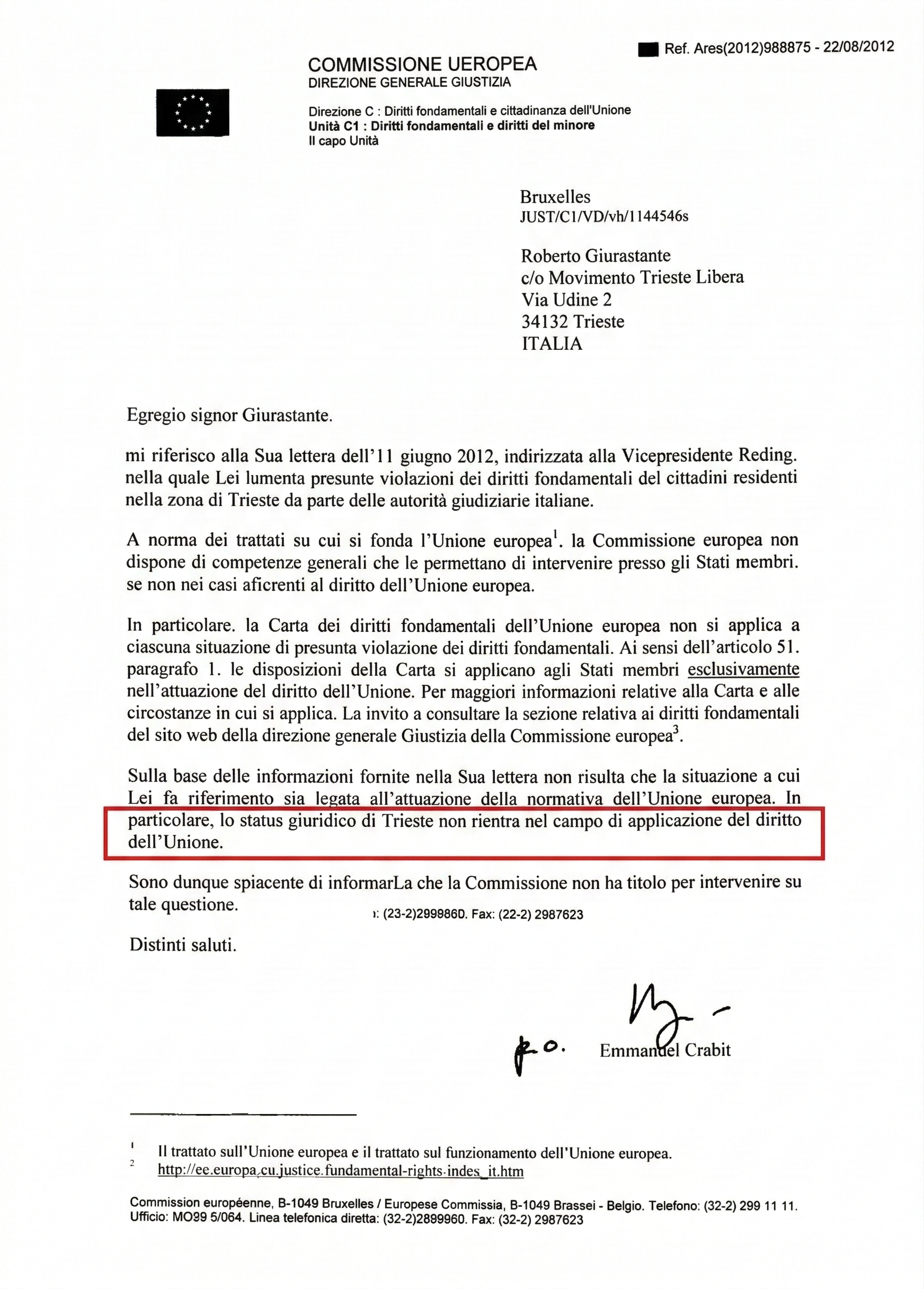
In other words: a legal grey zone.
The city is administered by an EU member state, yet its legal origin remains tied to the Paris Peace Treaty of 1947, which established the Free Territory of Trieste and the International Free Port.
For decades this framework remained beneath the surface, like certain Karst watercourses that flow invisibly beneath the rock.
But when geopolitics once again makes Trieste strategic — as is happening today with the Danube corridors — international law resurfaces as well.
In Trieste people still debate whether all this exists or not.
Meanwhile Budapest is already laying the tracks.
“The Danube is Hungary’s road to the sea.”
— István Széchenyi
The Trieste–Koper paradox
Trieste has the International Free Port.
Koper does not.
Yet traffic grows in Koper (Capodistria).
The contrast becomes immediately visible when looking at the neighbouring port of Koper.
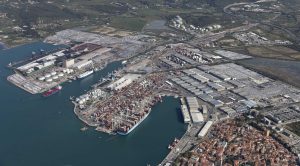
Port of Koper (Capodistria), Slovenia. Despite lacking the International Free Port status granted to Trieste in 1947, the port has become one of the fastest-growing logistics hubs in the northern Adriatic.
The timber trade is a perfect example.
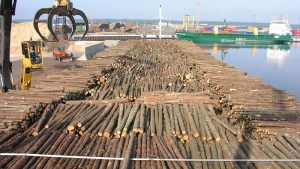
Timber cargo handled in northern Adriatic ports. Large volumes of Central European forest products move through the region’s logistics network despite Trieste historically hosting a dedicated Free Timber Port.
Trieste has a historic Free Timber Port, created precisely for the forest trade of Central Europe.
Today it is empty.
In Koper the yards are full of logs coming from Austria, Slovenia and Central Europe.
The reason is no mystery.
The Free Port of Trieste — perhaps not by accident — has been suffocated by a paralysing Italian administrative machine that seems designed specifically to discourage anyone who wants to work.
To operate in the port, a logistics operator must go through a real bureaucratic via crucis.
First the Eastern Adriatic Sea Port Authority.
Then the Customs and Monopolies Agency.
Then the Financial Police.
Then the Harbour Master’s Office.
Then the State Property Agency.
Then national port regulations.
Then administrative rules layered over decades.
Then permits.
Then inspections.
Then registrations.
Then controls.
Then new permits.
Then more controls.
A system created to facilitate international trade and transformed into an administrative swamp.
In Koper, by contrast, the port is managed by a single operator: Luka Koper d.d.
One interlocutor.
Fast decisions.
Fewer steps.
Fewer stamps.
Fewer offices.
The result is visible in the traffic figures.
Treaties may sleep. They do not disappear.
An international treaty can be ignored.
It can be forgotten.
But it remains valid until it is formally replaced.
The Peace Treaty of 10 February 1947 established the Free Territory of Trieste and the Free Port regulated by Annex VIII.
During the Cold War these provisions were frozen.
Not cancelled.
History shows that treaties may remain dormant for decades and then suddenly return to relevance.
The return of Hong Kong to China in 1997, for example, was based on an agreement signed almost a century earlier, in 1898, when the territory had been leased to the United Kingdom for ninety-nine years.
The sovereignty misunderstanding
According to the Grant–Verdirame legal opinion:
-
Article 21 of the Peace Treaty provided for the termination of Italian sovereignty over the Free Territory of Trieste
-
the Italian Court of Cassation, in the immediate post-war period, recognised Trieste as foreign territory with respect to the Italian state
If Italy today exercises sovereignty, it does so de facto, as a result of the situation consolidated over time.
A position that several jurists consider far from unassailable.
The Free Port: an international obligation
The London Memorandum of 1954 committed Italy to maintaining the Free Port according to Annex VIII of the Peace Treaty.
Annex VIII (Instrument for the Free Port of Trieste) forms part of the official English text of the 1947 Treaty of Peace with Italy, available in the UN Treaty Series.
-
Whoever administers Trieste must guarantee:
-
freedom of transit
-
customs exemption for goods in transit
-
access for the states of Central Europe.
-
Budapest is not asking for favours.
It is exercising rights provided by a treaty.
***
The ending no one in Trieste wants to hear
While in Trieste tricolour flags wave over half-empty squares
and military bands have been playing for decades for no one,
Budapest is building.
Terminals, railways, logistics corridors.
And in the valley of Muggia three reinforced concrete piers
with dredging for deep-water berths.
With facts, not ceremonies.
Serious states follow a simple order:
first geography,
then treaties,
finally infrastructure.
In Trieste the order is reversed:
first press conferences,
then flags,
and the treaties of 10 February 1947
are better left asleep.
Meanwhile Italian ministers arrive
who know little or nothing
about the historical and legal complexity of Trieste.
The Hungarians, on the other hand, know it very well.
And they act accordingly.
Because the accounts of history do not disappear.
They remain there.
And sooner or later someone reopens them.
Budapest is already doing so.
With concrete, dredgers and railway tracks.
If the Italian sovereignty over Trieste were truly so obvious,
there would be no need to remind everyone every year
with fanfares in empty squares and flags waving to themselves.
Secure sovereignties
do not need to be celebrated.
They simply exist.
***
Alessandro Gombač
Founder and first President of the Trieste Libera Movement
Trieste
Published by TRIEST NGO