
 newsletter
 contact us
 donations
Trieste, a city with sovereignty in suspension: why Italy believes it has it, while geopolitics tells a different story
Author’s note. An earlier version of this article appeared in Limes – Rivista italiana di geopolitica on 12 August 2026. This expanded version includes two documentary additions absent from the Limes text: European Commissioner Algirdas Šemeta’s reply of 7 August 2012 and UN Secretary-General Ban Ki-moon’s letter S/2015/809 of 21 October 2015. Read the article published by Limes.
A legal fault line beneath the present
In Italy, thinking of Trieste calls to mind the culmination of the Risorgimento in 1918 or the national redemption of 1954. Political rhetoric has frozen the city in those two dates, obscuring the real geopolitical watershed: 1947.
Yet while present-day Trieste enjoys its new status as an overtourism destination, distracted by perpetually full hotels, aperitif crowds and global consumerism, an active legal fault line works beneath the surface and releases tension into contemporary international relations.
Attention turns to disputed quays, European trade corridors and new logistics routes. Meanwhile, a latent legal framework, born in the opening months of the Cold War and never legally extinguished, resurfaces beneath the appearance of unquestioned sovereignty. It is an inconvenient precedent that the world of 2026 is rediscovering.
Everyone talks about ports, commercial corridors, Chinese penetration, agreements with the Hungary of Orbán and Magyar, and US bases. Few remember that a conditional sovereignty still hangs over this city: a hybrid legal regime born in the early Cold War and never brought to an end. This is not about exhuming an archival curiosity, but about examining a structural anomaly running through the foundations of contemporary international relations.
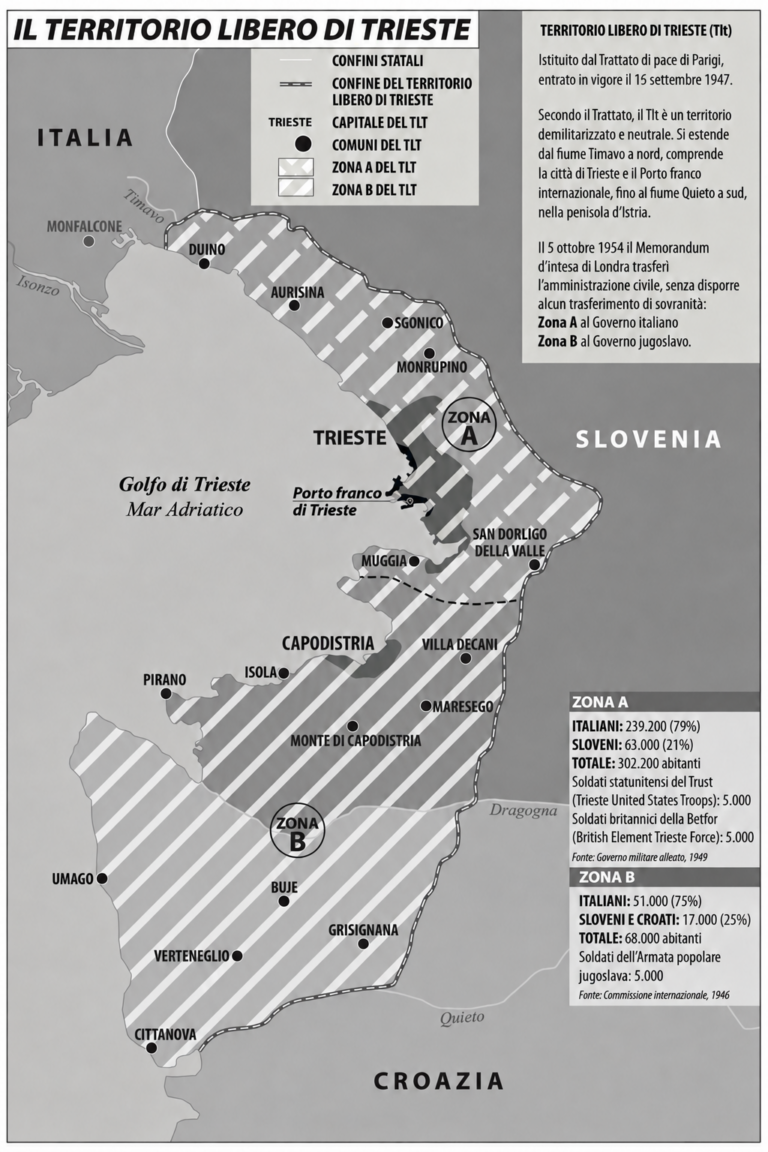
Administration is not sovereignty
The 1954 London Memorandum did not establish an “annexation by Italy” in the strict sense. It established a provisional arrangement. The instrument was not solemnly signed but deliberately initialled, reflecting the transitional character of the agreement: a diplomatic expedient that helped Tito secure Zone B while allowing governments in Rome to sustain the public illusion that the Istrian territories might one day be returned, at least as far as the Mirna (Quieto) River.
The wording officially communicated to the United Nations, when that institution still carried real political weight, was explicit: “practical arrangements”. The Allied Military Government ceased its functions in Zone A, but the transfer to the Italian Government, rather than the Italian State, concerned civil administration, not full and uncontested sovereignty. 2
The distinction was understood within Italy’s own institutions. As early as April 1950, the Rassegna mensile dell’Avvocatura dello Stato, discussing the property of public bodies, treated the Free Territory of Trieste as a concrete legal and property-owning entity with a personality distinct from that of the Italian State.
It is in this context that the judgments of the Joint Civil Sections of the Court of Cassation in 1961 and of the Council of State in 1962 belong. Italy’s highest judicial bodies recorded the persistence of a special regime that domestic law struggled to place under ordinary national sovereignty, on the eve of the regional settlement imposed in 1963. 3 4
Confidential US diplomatic records also attest to the persistence of this international legal framework. In a State Department cable dated 9 April 1974, document 1974STATE071519, since declassified, Washington instructed its diplomats in Rome and Belgrade to avoid describing Trieste as the “former Free Territory of Trieste”. The internal briefing stated that the 1954 arrangement “did not terminate juridical status of Free Territory”: it substituted civil for military administrations without affecting its “continuing legal character”. 5
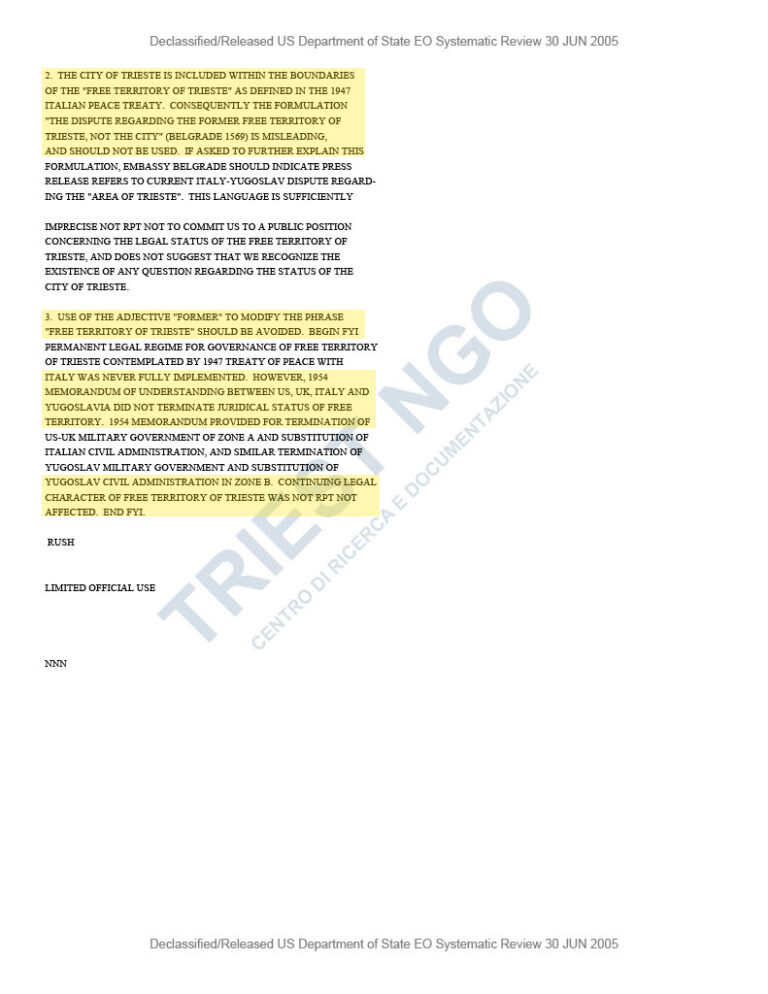
Second page of the 1974 US State Department cable, declassified on 30 June 2005. Washington advised against using “former” before “Free Territory of Trieste” and stated that the 1954 London Memorandum did not end the Territory’s legal status: it replaced the military governments in the two zones with Italian and Yugoslav civil administrations. The cable concludes that its continuing legal character was unaffected. The crucial passages are highlighted.
A much more recent institutional reference comes from the United Nations. In a letter dated 21 October 2015 and circulated on 23 October as S/2015/809, Secretary-General Ban Ki-moon transmitted to the president of the Security Council a Secretariat survey of historical precedents for the international administration and protection of territories. It had originally been prepared in response to the Palestinian request for a UN protection system.
Section V of the annex, “Free Territory of Trieste (1947)”, recalled that the Peace Treaty entered into force on 15 September 1947 and “terminated Italy’s sovereignty over the Territory”. It added that the Security Council could not discharge the responsibilities assigned to it by the Treaty because no Governor could be appointed, and that under the 1954 Memorandum Italy and Yugoslavia respectively established civil administrations in the two zones previously administered by the Anglo-American forces and the Yugoslav army. The document lists Articles 4, 21 and 22 and Annexes VI–VIII of the 1947 Peace Treaty, together with Security Council Resolution 16 (1947), as the legal basis of the UN role; it also cites the London Memorandum of 5 October 1954.
The 1975 Treaty of Osimo does not appear. That omission does not call into question Osimo’s bilateral effect between Italy and Yugoslavia. It does show that, in reconstructing the Trieste precedent and the UN’s role in 2015, the Secretariat continued to rely on the 1947 Treaty, Resolution 16 and the 1954 Memorandum, without attributing to the Italian-Yugoslav agreement the power to extinguish or alter the multilateral regime of 1947 and the rights it confers on third states. 6 7
London, Washington and the strategic condominium
Accounts of Zone A between 1945 and 1954 tend to focus on Washington and overlook the crucial British military occupation. Trieste was not solely an American enclave: it was an Anglo-American strategic condominium. For almost a decade British forces exercised full powers and direct military administration over the territory and its port under a special framework quite separate from Rome’s legal order.
London and Washington were the last international actors to exercise full governmental authority and military command over Zone A. The last two Allied Military Governors of the Free Territory, Generals Terence Airey and Thomas Winterton, were both British. That fact speaks to the strategic importance of British control over Trieste in the postwar Mediterranean and Atlantic balance.
Official documents examined in the legal opinion by Thomas D. Grant and Guglielmo Verdirame are equally clear. A British Foreign Office document of 1 May 1952, cited in their opinion, says that His Majesty’s Government and the United States jointly exercised authority over Zone A under the Treaty of Peace with Italy.
Although the British Empire was already in decline, forced to retreat globally by the economic and political burden of its overseas possessions, Britain retained an absolute veto over Trieste. Without London’s assent, the diplomatic machinery of 1954 would never have started.
The real political feat came next: the Anglo-American military occupation was recast as Italian civil administration. In the author’s view, that administration inherited and perpetuated the logic of special control, leaving the Trieste governorship enclosed ever since within a policing and judicial apparatus out of proportion to the city’s size. Britain was co-author of an exceptional legal architecture whose weight is still felt today. 8 9
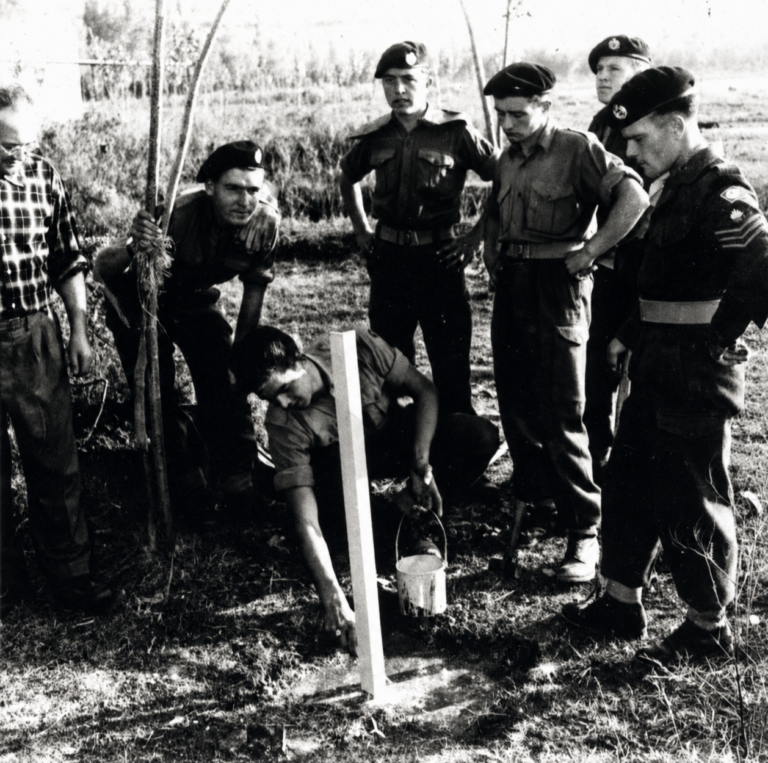
Free Territory of Trieste, 1947. British BETFOR personnel place a boundary marker along the demarcation line between Zone A, under Anglo-American military government, and Zone B, under Yugoslav military administration. The line separated two administrative sectors of the international territory established by the Peace Treaty, rather than two sovereign states.
The Free Port and the continuing relevance of Annex VIII
In this setting, the International Free Port envisaged by Annex VIII of the 1947 Peace Treaty is no minor customs detail: it is the material heart of the dispute. It was established as an international regime benefiting, and involving, several states, especially those of the Balkan and Danubian hinterland. The 1975 Treaty of Osimo, by contrast, was a bilateral agreement between Italy and Yugoslavia, sought by the United States to defuse potential crises on NATO’s southeastern flank as Tito’s death approached.
Under international law, a bilateral agreement cannot by itself extinguish or modify multilateral rights and regimes as against third states. Accordingly, the Free Port cannot simply be treated as an ordinary Italian state-owned port. It remains, in this author’s legal argument, an autonomous and protected entity that Rome cannot reshape or privatise at will without breaching international obligations. 10 11
A distinct, narrower but significant confirmation came from the European Commission. Answering written question E-006217/12, tabled on 22 June 2012 by MEP Mara Bizzotto, Commissioner Algirdas Šemeta expressly referred on the Commission’s behalf, on 7 August 2012, to Annex VIII of the Peace Treaty of 10 February 1947. He noted that Article 1 provides that the port of Trieste “shall be a customs free port” and that Article 5(2) bars customs duties or charges on goods imported, exported or in transit other than payments for services rendered.
He added that, within EU law, this position was secured by the port’s operation as a free zone, then a Type I control free zone under Article 166 of the Community Customs Code, in which non-Union goods were not subject to duties. He also mentioned possible VAT exemptions under Articles 156 and 160 of Directive 2006/112/EC. Published in the Official Journal of the European Union, C 183 E, on 28 June 2013, page 49, the answer naturally made operations subject to EU customs rules and did not address the territory’s overall status. That limited scope makes the point all the clearer: the Commission did not treat Annex VIII as an obsolete historical relic, but as a legal premise of the special customs regime, connected to EU law. 12
The strategic bargain of 1954
The transition of 1954 cannot be separated from its global setting. Trieste’s return to Italian civil administration falls in a remarkably compressed sequence: the London Memorandum was initialled by the United States, United Kingdom, Yugoslavia and Italy on 5 October 1954 and took effect on 26 October; the Bilateral Infrastructure Agreement (BIA) was signed on 20 October.
Within that strategic context Italy assumed administration of the governorship and made an agreement with the United States concerning military bases and infrastructure. The close timing allows the two instruments to be read as parts of a single Atlantic realignment, but does not in itself prove a formally agreed exchange. That realignment confirmed Italy’s subordinate integration into the Atlantic strategic architecture.
In the founding language and agreed interpretations of the NATO treaty, Anglo-American forces stationed in Trieste were expressly described as “occupation forces”. The paradox took shape then: an appearance of Italian sovereignty over the territory alongside effective operational control retained by Western powers, led by the United States, over key areas of security, legal affairs and maritime infrastructure. 13 14
Trieste amid the return of geopolitics
Trieste’s geography is now taking its revenge on history. The contemporary world has returned to nineteenth-century logic on a global scale: deep-water ports, railway networks, inland terminals and oil pipelines have become direct instruments for projecting power.
Trieste commands an extensive Central European hinterland reaching Slovenia, Croatia, Bosnia and Herzegovina, Serbia, Austria, Germany, the Czech Republic, Slovakia, Hungary, the Balkans and beyond. It attracts continental and global investment, helped by official port figures indicating depths of up to 18 metres in the heart of south-central Europe, suitable for some of today’s largest commercial and military vessels.
The port therefore remains a possible northern Adriatic terminus for IMEC, a strategic corridor currently stalled by the Middle Eastern crisis but perhaps capable of reshaping global routes under US leadership if the region stabilises. This is a scenario, not a terminus designated in the IMEC memorandum. 15 16
The geopolitical force of this cum finis, a boundary where Latin, Slavic and Germanic worlds meet and define one another, was already apparent in the nineteenth century. In 1890 Friedrich Engels identified the Danzig–Trieste axis as a hinge of continental tensions, suggesting that Russia’s natural frontier might run from Danzig, or perhaps Stettin, to Trieste. Nearly a century later, in his famous Fulton speech of 5 March 1946, Winston Churchill invoked the iron curtain descending “from Stettin in the Baltic to Trieste in the Adriatic”. 17 18
Two historians, from different perspectives, recognised the persistence of the Trieste problem. Giampaolo Valdevit described it as an “erratic boulder” that left its debris behind even after disappearing as such: provisionality trapped the city and became a durable sediment of local political culture, later developing into municipalism. Much water, he observed, had passed in the attempt to wash it away, but perhaps not enough.
Bogdan C. Novak made a more explicit prediction. Though he considered the 1954 compromise workable, he warned that a major Italian economic crisis might lead Triestines to turn toward their hinterland, demand the city’s internationalisation and build economic ties with Yugoslavia, Austria and the rest of Central Europe. He also foresaw that a Yugoslav crisis after Tito’s death, potentially ending in civil war or the country’s breakup, might reopen the Trieste question. Nationalism and imperialism, he concluded, might return it to world attention. 19
In today’s disorder, Russia and China invoke old multilateral treaties cynically and instrumentally to exploit fissures within the Western bloc. The fault line is moving again. One need not formally repeal the special regime of 1947 to neutralise it: taking functional control may be enough.
The prospect emerging toward 2030 raises troubling questions. The Trump administration’s inclination to sharply reduce conventional US military presence in Europe could dismantle the traditional model of collective Atlantic defence in Germany and Italy. Yet in a transactional worldview, where power is measured by material control of assets and commercial flows, logistics infrastructure can matter more than national flags. Washington has shown itself willing to assert economic and transactional claims over strategic places, as in provocations concerning Canada’s borders, Greenland and the Panama Canal. It might relax its conventional military presence in this region while tightening its grip on the outpost in the Gulf of Trieste.
The functional contest over the port
British American Tobacco’s substantial recent industrial investment in the “FREEeste” area at Bagnoli della Rosandra is, in this reading, the most tangible sign. The Anglo-American multinational, which effectively took over Italy’s former state tobacco monopoly, ETI, in 2003, has consolidated manufacturing and logistics operations there. The author connects this presence with the advantages of the special fiscal regime; BAT’s own announcement establishes the investment and location, not that legal or fiscal interpretation. 21
The United States and United Kingdom were, after all, the last international actors to hold direct military administration of Zone A of the Free Territory. The provisional settlement of 1954 could prove to be a dormant emergency mechanism, functionally reactivated by the Anglo-American powers. In this scenario, the aim would be to secure the port before it is drawn into strategic axes hostile to Washington and London, associated with Moscow and Beijing, which might see the Free Port’s international character as an opening into European balances.
Against this backdrop of new global tensions, Trieste again resembles a contested territory, echoing dynamics of 1947. The continental dimension is already material: Budapest has acquired the 34-hectare former Aquila port area, an operation the author interprets as a substantive exercise of the preferential access and use available to hinterland states under the international regime of 1947. Talks between Rome and Budapest about a fiscal corridor connecting Trieste and the Hungarian capital point in the same direction.
What are these operations, ultimately, if not a functional return to the logic of Annex VIII of the Peace Treaty? Hungary’s move is no isolated incursion but, in this author’s interpretation, a foothold secured by multilateral treaty rights, placing Eurasian commercial interests in the northern Adriatic. The ultimate paradox would be a Trieste formally shown on Italy’s national map but strategically beyond the effective authority of Rome and Brussels over logistics, flows and security.
The political language behind this presence was explicit as early as 2019. The claim often paraphrased in Italy as “Trieste will be Hungary’s port” has a primary source in a Hungarian foreign ministry release of 27 July 2019 about Minister Péter Szijjártó’s interview with Origo. It uses the phrases “Hungarian seaport in Trieste” and “Hungarian maritime exit”, arguing that direct control of an outlet would give Hungarian exporters reliability and predictability.
Szijjártó described Trieste as the best solution for proximity, road and rail connections, capacity and development potential. He announced a state investment of €100 million and plans to double rail traffic, then at least one container train per day. The move from statement to physical project was reiterated in February 2025, when Deputy Minister Levente Magyar visited with Italian Deputy Minister Edoardo Rixi and presented the terminal as a way to end a landlocked exporting country’s dependence on others’ infrastructure. This is more than a Central European metaphor: Budapest officially describes the Trieste site as its own seaport and its access to global supply chains. 22 23
A de facto logistics sovereignty set against nominal sovereignty. Institutions, meanwhile, have left a legal blind spot. In a note of 22 August 2012, Ares(2012)989875, signed by DG Justice unit head Emmanuel Crabit in reply to a complaint about alleged fundamental-rights violations by Italian judicial authorities, the European Commission stated that “the legal status of Trieste does not fall within the scope of EU law”. At the same time, in Limits in the Seas reports issued in October 2020 for Slovenia and September 2023 for Croatia, the US State Department formally declined to recognise those two former Yugoslav republics’ maritime jurisdictional claims over the waters concerned.
The most striking collision appears in recent Italian law. Article 71 of Legislative Decree No. 141 of 26 September 2024 states in the Gazzetta Ufficiale that the provisions of Annex VIII of the Peace Treaty of 10 February 1947 remain in force for the free zones of the port of Trieste. The Italian state has thus expressly retained an international legal source that national political rhetoric often dismisses as archaeology. The provision does not, by itself, determine territorial sovereignty. 24 20 25
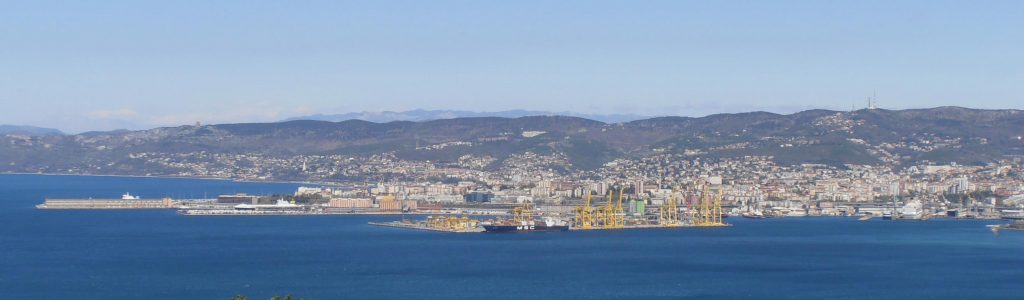
Trieste’s New Port seen from Muggia. At the centre are Pier VII and the container terminal: the material heart of a port system whose international regime, established by Annex VIII of the 1947 Peace Treaty, continues to distinguish Trieste from an ordinary national port.
An excess of remembrance and a political vacuum
The legal paradox challenges an institutional myth. Since 1954, patriotic rhetoric has frozen a provisional Cold War strategic compromise into the final fulfilment of Trieste’s Italian identity. That narrative may have helped social cohesion after the war, but today its fragility is increasingly apparent: as legal, economic and geopolitical contradictions resurface, national belonging is reaffirmed all the more insistently through flags, ceremonies and anniversaries. Repetition begins to look like insecurity. A city whose status were as unquestioned as Padua’s or Florence’s would hardly need its belonging ceremonially reconfirmed at every turn of the calendar.
Since the second decade of this century, and particularly in recent years, Trieste’s civic calendar has filled with commemorations. The withdrawal of Yugoslav troops on 12 June, under the Belgrade Agreement of 9 June 1945, was elevated in 2020 to a solemn “Day of the Liberation of the City of Trieste from Yugoslav Occupation”, complete with flag-raising and lowering, the civic banner and military ceremonies. The London Memorandum and 26 October are celebrated as confirmation of Trieste’s “return to Italy”, obscuring both the agreement’s provisional character and the difference between transfer of civil administration and transfer of sovereignty.
More recently, commemorations of the Vergarolla explosion have grown, often attributing it to Tito’s forces although the Allied investigation did not identify those responsible. Ceremonies at the Basovizza foiba on 10 February have also expanded. That date, observed since 2004 as the Day of Remembrance, is also the anniversary of the signing of the 1947 Peace Treaty: the international instrument that imposed terms on defeated Italy, ended its sovereignty over Trieste and established the Free Territory.
This excess extends beyond the nationalist right and patriotic associations. It has increasingly influenced parts of Trieste’s left and centre-left, whose representatives, crossing the Isonzo from the west, often adopt the vocabulary of irredentism and the memorial outlook of the local right. What results is a continuing competition to affirm Italian identity, turning each anniversary into an identity marker and casting every attempt at critical historical reconstruction as revisionism or disloyalty.
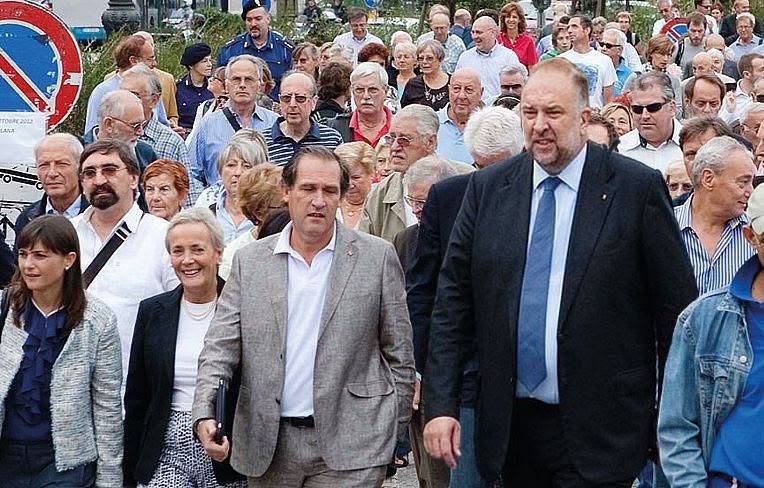
Trieste, 29 September 2012. A counter-demonstration by the local political establishment heads toward the Old Port. In the front row are Roberto Menia, Maria Teresa Bassa Poropat, Debora Serracchiani and Roberto Cosolini; Roberto Antonione follows behind. The image was politically unusual: figures from the communist and post-communist left marched alongside men formed in the Italian Social Movement. At the same time, about 3,000 demonstrators inside the Old Port called for application of Annex VIII of the 1947 Peace Treaty. Former communists and former members of the post-fascist right marched together: for one day, fear of Annex VIII united them.
Hostility now reaches symbols of Slovenian anti-fascist memory. Red flags traditionally flown on May Day in the Karst villages are denounced as provocations, while nationalist associations campaign to display Italian tricolours in response from 30 April to 12 June.
The symbolic contest reaches the city’s institutional centre. The Italian tricolour flies permanently on City Hall, rather than only on national occasions, in place of the historic red civic flag bearing the halberd. The practice dates to a national campaign launched by the Prodi government in 1997 in response to Umberto Bossi’s insults to the Italian flag. What was meant to be temporary became permanent in Trieste.
Later legislation required the display of the Italian and European flags in specified institutional circumstances, but did not require the civic emblem to be permanently displaced. This permanence is politically revealing: every day the city chooses the state flag over its own historic banner, as if it must continually attest to its national belonging.
As Monfalcone, Koper/Capodistria and the wider northern Adriatic are shaped by productive integration, labour mobility and cross-border logistics, Trieste remains trapped in a ceremonial version of the twentieth century. A funereal cult of the past has become a political prison in the present.
It recalls Friedrich Nietzsche’s warning about the damage caused by too much history: monumental and antiquarian fetishism can mummify the present, drain its vitality and prevent action. While the city is consumed by retrospective obsessions, real geopolitical issues restart quietly. Claudio Magris captured the point when he called Trieste “a seismographic centre of Europe, where the earthquakes of history announce themselves in advance”. Today dormant legal tensions are awakening in precisely that place.
Yet as the international environment hardens, Trieste appears politically mute, resigned to the shadow of a national political scene itself short on strategic vision. No unifying local force can currently turn the complexity of these changes into a serious political programme or use the territory’s legal and strategic memory to shape one. There are fragments, self-referential nostalgias, irrational tiny groups and private resentments, but no movement capable of bringing the population consciously into the transformation ahead.
This widespread lack of awareness hinders any effort to protect rights. It makes it particularly difficult for residents to claim the civil rights they consider denied, beginning with the original autonomous citizenship established in Annex VI of the 1947 Peace Treaty. Its claimed present-day effects remain a legal argument, not a matter settled by a final judicial decision. Without strategic awareness, the law is a dead letter. Once again the city risks simply absorbing decisions made elsewhere, discovering their effects only when they cannot be reversed.
The strategic landscape is open again
The future has already begun. A legal epicentre is moving again, and this time the tremor brings more than the dust of archival papers. It brings the cold pressure of terminal operators, global investment funds, secured pipelines and strategic corridors controlled by outside interests.
The territory is being reduced to a mere transit route for containers, the poorest and most peripheral form of contemporary logistics. Meanwhile, the commercial character of its free zones, which made Trieste prosperous and central for centuries, is quietly erased. That character rested on more than the movement of goods: it involved their processing, manufacturing, financing and redistribution throughout Central Europe.
As the international-law opinion by Thomas D. Grant and Guglielmo Verdirame also shows, questions concerning Trieste’s suspended sovereignty are not local folklore. They raise genuine issues, argued bona fide, in public international law. The geopolitical repercussions of this deep anomaly already touch Italy, Slovenia, Croatia and Hungary. The dispute concerns more than quays, railways and inland terminals. It also reaches the international legal character of the Gulf’s “occupied waters”, whose sovereignty, in the author’s view, remains an unresolved geopolitical question at the heart of the Atlantic strategic system. The landscape is open, and the geopolitical contest has resumed. 26
Alessandro Gombač
President of TRIEST NGO
Documentary notes
- Treaty of Peace with Italy. Signed 10 February 1947; entered into force 15 September 1947. For Trieste, see especially Articles 4, 21 and 22 and Annexes VI–VIII. The UN Treaty Series contains the text and registration details. Source
- London Memorandum of Understanding. 5 October 1954, UNTS vol. 235, No. 3297. It provides for “practical arrangements” and the transfer of responsibility for administering the two zones; it does not use the word “annexation”. Source
- Italian State Attorney’s Office. “Condizione dei beni degli enti parastatali nel Territorio Libero di Trieste”, Rassegna mensile, April 1950. A contemporary Italian source treating the FTT as a separate legal order. Source
- Italian case law. Court of Cassation, Joint Civil Sections, 18 September 1961, No. 2026; Council of State, Section IV, 16 January 1962, No. 5. These rulings must be read in light of the specific proceedings: they attest to problems associated with the special regime but are not general rulings on sovereignty. Source
- Cable 1974STATE071519. US State Department, 9 April 1974, subject “Trieste Zone B Dispute”; “Limited Official Use”, declassified and released 30 June 2005. A copy of the NARA-AAD output is held in the author’s archive. Paragraph 3 instructs officials to avoid “former” before “Free Territory of Trieste”, stating that the 1954 Memorandum “did not terminate juridical status of Free Territory” and that its “continuing legal character […] was not affected”. Paragraph 2 also places the city of Trieste within the FTT boundaries defined by the 1947 Treaty. Source
- Letter S/2015/809. Ban Ki-moon to the president of the Security Council, 21 October 2015, annex, Section V, “Free Territory of Trieste (1947)”. The account sets out the historical precedent and UN legal bases. The omission of Osimo does not in itself constitute a ruling on the validity or effects of the 1975 treaty. Source
- Resolution 16 (1947). Security Council, 10 January 1947: acceptance of the responsibilities contemplated in the annexes to the forthcoming Peace Treaty for the Free Territory of Trieste. Source
- Grant–Verdirame legal opinion. Thomas D. Grant and Guglielmo Verdirame, commissioned legal opinion, December 2016. It discusses Foreign Office material dated 1 May 1952. It is a commissioned opinion, not an act of a court or government. Source
- House of Commons debate. 12 May 1952. A British minister stated that the administrative measures then announced did not change Zone A’s “basic juridical position”: an official contemporary distinction between administration and legal status. Source
- Annex VIII. International Statute for the Free Port of Trieste, integral to the 1947 Treaty. Articles 1, 2, 5 and 16 establish its purpose, customs regime, freedom of transit and the rights of interested states. Source
- Treaty of Osimo. Italy–Yugoslavia, 10 November 1975; entered into force 11 October 1977, UNTS vol. 1466. The source establishes its terms and bilateral effect; its relationship with the multilateral regime of 1947 is the author’s legal argument. Source
- Reply E-006217/2012. Algirdas Šemeta, on behalf of the European Commission, 7 August 2012; Official Journal of the EU C 183 E, 28 June 2013, p. 49. The reply cites Annex VIII and explains how customs and VAT rules connect it to EU law; it does not address territorial status. Source
- Bilateral Infrastructure Agreement. Italy–US agreement of 20 October 1954. Its original text does not appear to have been published in full; a later official US–Italian agreement confirms its existence and purpose. Its contemporaneity with the London Memorandum is documented, while a formal exchange between the two remains a geopolitical interpretation. Source
- Occupation forces and NATO. See the State Department memorandum of 13 March 1953 for the legal and diplomatic context of Anglo-American forces in Trieste and the North Atlantic Council communiqué of 22 October 1954 for the subsequent political framework. Source
- Port of Trieste data. The Port System Authority gives natural water depths of “up to 18 metres”. The figure of 22 metres in earlier versions was removed because the institutional source consulted did not support it. Source
- IMEC corridor. Political memorandum signed in New Delhi on 9 September 2023. It outlines two corridors but does not designate Trieste as a terminus; any such role is therefore an analytical scenario. Source
- Friedrich Engels. “The Foreign Policy of Russian Tsardom”, published in 1890. This is the source for the passage about a possible Russian natural frontier from Danzig/Stettin to Trieste. The year 1848 given in an earlier version was incorrect. Source
- Winston Churchill. “The Sinews of Peace”, Westminster College, Fulton, 5 March 1946: source of the phrase “from Stettin in the Baltic to Trieste in the Adriatic”. Source
- Valdevit and Novak. Giampaolo Valdevit, Trieste 1953–1954. L’ultima crisi?, Trieste, MGS Press–Il Piccolo, first edition October 1994, pp. 73–74; Bogdan C. Novak, Trieste 1941–1954. La lotta politica, etnica e ideologica, translated by Graziano Azzimonti, Milan, Mursia, first Italian edition March 1973, p. 441 (original edition, University of Chicago Press, 1970). The quoted pages and publication details are documented by photographs of copies held in the author’s archive.
- Freedom of Navigation. The US Department of Defense’s official annual reports list maritime claims it contests and the “operational assertions” carried out by US naval forces. These are military operational records; they neither settle sovereignty over the Gulf nor replace an international maritime delimitation. Source
- BAT investment. British American Tobacco’s 27 June 2023 release on the opening of its Trieste Innovation Hub described a planned investment of up to €500 million over five years. It establishes the investment and location, but not the legal or fiscal characterisation advanced in the article. Source
- Hungarian port in Trieste. Hungarian Ministry of Foreign Affairs and Trade, 27 July 2019: the release uses “Hungarian seaport in Trieste” and “Hungarian maritime exit” and announces a €100 million state investment. Source
- Former Aquila site. The Port Authority’s 2019 annual report describes the Hungarian project and the area’s arrangements. The connection to a “preferential right” under Annex VIII is the author’s legal characterisation, not the wording of the purchase deed. Source
- DG Justice note Ares(2012)989875. European Commission, Directorate-General Justice, Directorate C, Unit C1, 22 August 2012; addressed to Roberto Giurastante at Movimento Trieste Libera and signed by unit head Emmanuel Crabit. A copy is held in the author’s archive. Replying to a letter of 11 June concerning alleged fundamental-rights violations by Italian judicial authorities, it states that “the legal status of Trieste does not fall within the scope of EU law”. This is administrative correspondence about the Commission’s competence, not a decision on sovereignty. The sentence also appears in Italian parliamentary records. Source
- Legislative Decree No. 141 of 26 September 2024. Article 71 preserves the application of Annex VIII of the Peace Treaty to the free zones of the port of Trieste when coordinating national customs law. This reference confirms the Annex’s relevance in Italian law; it does not by itself settle territorial sovereignty. Source
- FTT citizenship. Annex VI, Article 6, of the Peace Treaty established original citizenship of the Free Territory. The present-day effects claimed in the article are a legal thesis, not established here by a final court ruling. Source