
 newsletter
 contact us
 donations
Trieste, 18 October 2021: tear gas and the advance of police forces in the urban area adjacent to Gate 4 of the International Free Port.
Trieste has an old, stubborn characteristic: you can try to forget it, to bury it, to declare it a “closed matter,” but it always reappears — as a file left open on a ministerial desk, and on those foreign chancelleries’ desks where Trieste’s uncertain status has never been archived.
For seventy years, it has been the return of the repressed in Italian politics.
And every time it resurfaces, it weighs more than the time before.
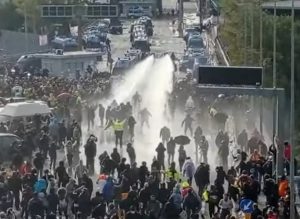
Trieste, 18 October 2021: water cannons advancing from inside the International Free Port, a demilitarized and extraterritorial area as established by the 1947 Peace Treaty.
On 18 October 2021, in front of Gate 4 of the International Free Port, amid water cannons, tear gas and police vans, the question Italy has avoided for seven decades re-emerged:
what were armed forces doing inside a demilitarized port, in a Territory that does not legally belong to them?
A simple question.
And like all simple questions, it is the one that frightens the most.
A senator, an official act, and a silence heavier than any answer
Few remember it — many prefer not to — but in those days a Senator of the Republic, Gianluigi Paragone, submitted a written parliamentary question to the Ministers of the Interior, Defence and Foreign Affairs.
The text? Drafted by TRIEST NGO and refined by the Senate’s Legal Service.
In other words: unassailable, verifiable, institutional.
And there is a detail worth recalling.
It was Paragone himself who asked us for the text.
He brought it to the Senate Legal Service for formal review and — let’s be honest — based on experience, we were prepared for the worst: cuts, dilution, and the usual “decaffeination” applied whenever a document touches the State’s raw nerves.
Instead, the opposite happened.
Not only did the Legal Service refrain from removing anything, it strengthened the text, clarifying legal references and tightening several formulations — paradoxically, to our advantage.
They returned the document exactly as it was — only more solid.
And Paragone presented it in that very form, without altering a comma.
It wasn’t a press release, nor a protest.
It was an official act of the Italian Parliament placing on the table the legal status of the Free Port and the Free Territory of Trieste.
Rome never replied.
Not out of indifference.
Not out of lack of time.
It was the silence of panic — the kind that descends when a burning document arrives in Parliament and no one dares touch it, not even with gloves.
Paragone himself admitted it: after filing the question, an icy chill spread through the corridors.
Lowered eyes, silent phones, and that well-known deafening silence of the Roman palaces.
Not because the text was extreme.
Because it was well-founded.
The questions no one wants to see on the table
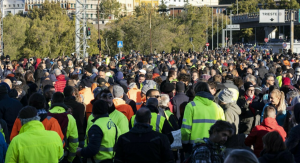
October 2021 – peaceful demonstrators in front of the International Free Port of Trieste: no threat, no violence, and no authorization from the UN Security Council for the use of force.
Five simple, devastating questions.
Heavier now than in 2021.
-
Are you aware of the legal status of the International Free Port?
Translated: do you even know where you are? -
Did you request authorization from the UN Security Council to use force in an extraterritorial area?
The answer is no.
And that alone would suffice. -
On what legal basis did you authorize the entry of armed forces into a port demilitarized by the Peace Treaty?
No UN authorization has ever existed. -
Did the Government Commissioner act as an Italian prefect or as an administrator of a Territory never annexed to Italy?
A question that, on its own, makes ministries tremble. -
Were police forces aware they were operating under the aegis of the UN Security Council?
Here the fork opens:
incompetence or deliberate violation.
Five questions.
Five minutes to answer.
But at the Ministry of the Interior and the Ministry of Foreign Affairs, not even a single official — not even a junior one on a temporary contract — was willing to sign a line.
In politics, as in life, silence is an answer.
Often the most compromising one.
Why this parliamentary question now weighs like lead
In 2021 Rome could take refuge in the climate of emergency — amplified by the public anxiety of the pandemic years.
In 2025, not anymore.
The world has changed:
-
China is redesigning Eurasian trade routes;
-
the United States is trying to militarize them through IMEC;
-
Hungary has already secured a piece of port — and a piece of leverage;
-
Serbia looks at Trieste as its natural sea outlet;
-
Russia watches every crack in Europe’s post-1945 order.
In this scenario, Paragone’s parliamentary question becomes documentary evidence of everything no Italian government dares to say:
-
The Free Territory of Trieste is not closed: it is suspended.
-
The Free Port is under UN, not Italian authority.
-
Demilitarization has never been revoked.
-
Italy exercises powers it cannot legally justify.
Italy fears these questions — and has good reasons to.
Because answering them would mean:
-
admitting that the London Memorandum did not amend the Peace Treaty;
-
explaining the illegal use of armed forces inside the Free Port;
-
acknowledging that the UN was never consulted;
-
and above all, recognizing that Trieste is not a local curiosity, but an open international dispute, with future effects that are easily imaginable for the entire south-eastern European region.
Those who govern know it well:
there are truths one does not answer — one avoids them.
2025: the file returns. Not by chance.
That parliamentary question has not aged.
It remained there, unmoved, like a time-triggered device in international law: dormant, yet active.
Because Trieste is — and has been for seventy years — the return of the repressed: the uncomfortable truth the State tries to bury, and that resurfaces precisely when it is least expected.
And the real question today is another:
How much longer can this fiction continue, before someone — a State, an embassy, or the UN Security Council — decides to check the one who claims to be in charge?
The Free Port and the Free Territory of Trieste are not opinions.
They are acts, treaties, parliamentary documents.
They exist, and they endure.
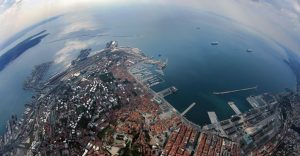
The International Free Port of Trieste: an extraterritorial and demilitarized area as established under the 1947 Peace Treaty.
Questions do not age.
Only those who evade them do —
and the archive does not forget.
Least of all those who are formally its guarantors.
– Alessandro Gombač –