
 newsletter
 contact us
 donations
Special Dossier — Strategic Vision and Governance of the Upper Adriatic (Part 1)
Seen from above, the Gulf of Trieste forms a geometric mosaic of grey and green, where the asphalt expanses of logistics platforms abruptly give way to coastal vegetation. From the marl and sandstone ridges overlooking Rabuiese, it becomes immediately clear that industrial development has not erased the natural character of the area.
Despite the imposing scale of the two commercial hubs — one located at the head of the Gulf of Trieste and the other in the adjacent Bay of Koper — the long and complex coastline linking Italy and Slovenia remains interspersed with extensive wooded and hilly areas: from the slopes of Muggia and Lazzaretto to the terraced fields of Ankaran, and onward to San Bartolomeo, Punta Sottile and Punta Grossa.
From these heights, this border landscape — suspended between the modernity of port terminals and stretches of nature that remain almost untouched — opens onto terraces cultivated with vines and olive trees as far as the eye can see. It is a rural landscape whose historical and material roots lie deep within this very system of hills.
Indeed, Monte Castellier — the hill overlooking the Noghere plain along the former boundary between Trieste’s Zone A and the former Yugoslav Zone B around Škofije and Ankaran — provided the ancient stone that helped pave the history of Trieste itself. Even Stendhal, in 1830, during a stay in Trieste otherwise notably short on compliments, praised the city’s paving, describing it, together with Milan’s, as the finest in Europe.
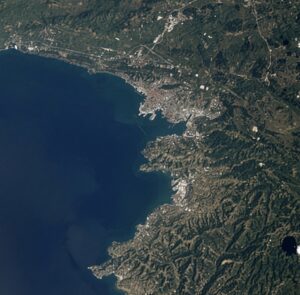
The geographical continuity of the Gulf of Trieste seen from space: within a single natural basin lie the hubs of Trieste and Koper, separated only by a narrow hilly ridge.
As early as the eighteenth century, during the construction of the Borgo Teresiano, grey sandstone quarried from these flysch formations was extensively used for land reclamation and port quays. During the nineteenth century, stone from the Muggia flysch became a standard material for squares and pavements, including Piazza Grande — today Piazza Unità d’Italia — and Molo San Carlo, now Molo Audace.
The characteristic masegni — large squared stone blocks used to pave the city’s streets and squares — came largely from these same quarries and still reappear whenever a layer of asphalt is removed. As the old local saying has it: “Trieste xe stada fata in piera de Muja” — “Trieste was built from the stone of Muggia.”
Today, looking down from those same hills, the vision of an integrated super-port does not require concreting over this protected coastline. Instead, it points towards an inland shortcut, invisible from the sea: an approximately seven-kilometre rail-only tunnel connecting the Noghere plain on the Trieste-Muggia side with the Ankaran plain behind the Port of Koper, physically linking their respective logistics hinterlands without disturbing the coastal environment.
On one side, Trieste’s Pier VII operates with natural water depths reaching 18 metres. Barely ten kilometres away, the terminals of Luka Koper handle steadily growing container flows but are increasingly forced to expand vertically as available land approaches exhaustion.
Yet the pressure on Koper does not come from containers alone. The Slovenian port today handles substantial volumes of bulk and specialised cargo: grain, livestock, automobiles — which require enormous storage and marshalling areas — and even timber.
These are precisely the types of cargo that historically passed through Trieste. Timber provides a particularly striking paradox. Koper has become the leading Adriatic hub for timber despite the existence, on the Trieste side, of a dedicated Timber Free Port area. For more than a century, that terminal was the natural maritime outlet for timber arriving from Austria and the entire Danube basin. Today, those flows have been diverted almost entirely to neighbouring Koper.
A specialised facility has consequently been left virtually unused, stripped of its historic traffic precisely because of the unsustainable Italian national bureaucratic and customs procedures that will be examined later in this dossier.
Two ports are separated by a political border, yet they lie within the same natural basin and serve the same Central European economic hinterland. More than any infrastructure project, it is this geographical proximity that reveals the existence of a system divided by history but stubbornly regarded by geography as a single whole.
While the two city centres lie approximately twelve kilometres apart as the crow flies, the actual distance between their respective industrial and logistics areas is only a few kilometres. Their physical proximity is almost immediate, yet they belong to two opposite political geometries: Trieste sits at the extreme periphery of Italy, while Koper constitutes Slovenia’s principal maritime gateway, barely one hundred kilometres from the Slovenian capital, Ljubljana.
It is a geopolitical anomaly virtually unique in Europe. Until the Second World War, the extensive countryside surrounding Koper was commonly regarded as “Trieste’s vegetable garden” — an agricultural umbilical cord supplying the city’s markets daily with fresh produce.
And yet an alternative to zero-sum competition exists, and it is no utopia.
In Northern Europe, Copenhagen and Malmö — historically divided by the waters of the Øresund and centuries of national rivalry — gradually transformed their border into shared infrastructure, creating one of Europe’s most integrated cross-border regions in economic, logistical and mobility terms.
If the Scandinavian strait could become a laboratory of cooperation, the Upper Adriatic possesses every condition necessary to attempt the same strategic transformation. Four kilometres cannot continue to function as a wall. They must become the common quay of a single, immense Central European hub.
Today, that geographical symbiosis — fractured by history and reshaped by the pressure of global trade flows — appears to be pushing the region towards a new form of cross-border functional integration.
The analysis that follows does not address the broader questions of entrepôt trade, industrial processing or the financialisation of goods. It concentrates instead on the architecture of intermodal transport and transit logistics.
The Paradox of Origins: From the Paris Peace Treaty to the Chinese Model
To understand the vital importance of this cross-border connection, statistical distortions must first be stripped away and the actual cargo figures examined. They offer a merciless picture of the balance of power within the Gulf.
Looking at the most dynamic segment of modern logistics — containers — the gap is striking.
In 2025, the Slovenian port of Koper exceeded 1.27 million TEU, consolidating its leadership in the Upper Adriatic while continuing an expansion programme designed to increase capacity still further. In the same year, Trieste handled approximately 682,000 TEU, affected in particular by the contraction of transhipment traffic.
The gap reflects not only different commercial strategies but also the greater speed of decision-making and operational execution within the Slovenian logistics system.
The real paradox, however, emerges when total tonnage is broken down.
Trieste has traditionally claimed the title of Italy’s leading port by overall tonnage, but this position is overwhelmingly determined by liquid bulk traffic. Of approximately 60 million tonnes handled in 2025, some 42 million tonnes consisted solely of crude oil entering the SIOT/TAL Transalpine Pipeline — almost 70 per cent of the port’s total traffic.
This is essentially transit cargo, producing a relatively limited impact in terms of port employment and the local logistics economy, since the crude oil is destined primarily for refineries in Austria, southern Germany and the Czech Republic.
Add to this the fact that solid bulk cargoes — including grain, timber and coal — are now handled almost entirely through the Port of Koper, and the picture changes radically.
Without crude oil, Trieste would fall to approximately tenth place among Italian ports in terms of cargo throughput.
This structural weakness demonstrates how Trieste, considered in isolation, struggles to compete in higher-value cargo segments.
At the same time, it confirms that the two ports are not natural competitors but structurally complementary.
Koper has cargo flows and containers, but its operational areas and opportunities for inland expansion are approaching saturation. Trieste, by contrast, possesses extensive logistics areas and the potential international legal framework required to support further development, yet has been unable to convert those advantages into a corresponding volume of commercial traffic.
Its apparent supremacy in total tonnage would lose much of its substance without the weight of the “black gold” flowing through the pipeline towards Ingolstadt and Bavaria.
The comparison with Shenzhen — China’s first Special Economic Zone, transformed in roughly forty years from a fishing settlement into a global hub — periodically resurfaces in economic discussions throughout north-eastern Italy.
To be fair, another comparison is frequently heard in the local press and political establishment: Trieste as a new Singapore.
That analogy, however, is misleading.
Singapore is a sovereign city-state, a financial and geopolitical giant of almost six million inhabitants, with its own currency and independent foreign policy. It is not simply a free zone or an industrial port embedded within the borders — and at least partly within the legislation — of another state.
The legal architecture necessary for a different model already exists. It is embedded in the Paris Peace Treaty of 10 February 1947.
Annex VIII describes the Free Port of Trieste not as a national port but as an international customs-free entity.
The international legal architecture is equally significant. On 10 January 1947, through Resolution 16, the United Nations Security Council approved the three annexes concerning the establishment of the Free Territory of Trieste (FTT), accepting responsibility for guaranteeing its integrity and independence.
Had that framework been fully implemented, the Upper Adriatic territory between the Timavo and the Mirna rivers would have possessed at its economic centre an international Free Port, equipped with customs-free areas for the storage, processing and transit of goods.
This legal specificity cannot simply be disregarded by the European Union framework, particularly in light of Article 351 of the Treaty on the Functioning of the European Union, which protects international obligations undertaken by Member States before the establishment of the European Communities.
In practice, the international Free Port regime has been implemented only partially and fragmentarily. It was first frozen by the Cold War and subsequently eroded by restrictive interpretations imposed through the machinery of national administration.
The Italian interministerial decrees adopted in 2017 — the so-called Padoan-Delrio package — attempted, or perhaps merely pretended, to stabilise the system. Yet they were burdened from the outset by a fundamental contradiction that ultimately undermined their effectiveness.
It was politically illusory to believe that two national ministries, acting through their administrative departments, could operate the Free Port of Trieste in accordance with the international requirements of Annex VIII using only the instruments of domestic administrative law.
That complex international architecture, born under the aegis of the United Nations, consequently collides with administrative practice on a daily basis.
Commercial flows must navigate the competences of no fewer than 21 public authorities capable, in various ways, of intervening in the port system*, while the Customs Agency controls internal access points and heritage authorities impose restrictions on old Habsburg warehouses, paralysing their technological adaptation.
This bureaucratic suffocation produces another paradox.
While everyday port operations suffer from severe administrative rigidity on the quays, enormous strategic assets are slowly being released immediately behind them: the approximately 70 hectares of the former Servola steelworks, currently undergoing remediation and already largely earmarked for port use, together with the free-zone areas of Zaule, Noghere and Prosecco.
These vast spaces, whether already available or undergoing conversion, risk remaining economically strangled unless bureaucratic constraints are removed and the entire system is connected through a single fluid infrastructure.
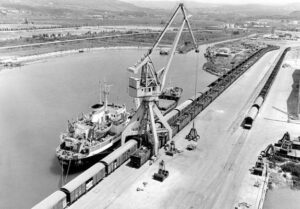
The early days of Luka Koper: the first operational quays and direct cargo transfers between ship holds and rail. A logistics hub whose growth emerged from the territorial arrangements of the post-war period.
The Missed Alternative: What If the FTT Had Actually Existed?
Had the Free Territory of Trieste been implemented de facto according to the framework envisaged by the United Nations, the logistical map of the Upper Adriatic would look entirely different today.
In 1947, the prospect of a major commercial terminal at Koper appeared in no strategic plan. The future Luka Koper was not even on the planners’ horizon, and the harbour consisted essentially of a modest fishing port alongside the historic town centre.
This is not merely a retrospective conjecture.
Yugoslav archival documents from the period confirm that even in 1954 Trieste was described without ambiguity as “our best port and the one with the greatest capacity” — Trst kot naše najboljše pristanišče in z največjo kapaciteto — demonstrating that Belgrade still regarded Trieste as the natural maritime outlet of the Danubian and Balkan hinterland.
Moreover, during the complex negotiations leading to the 1954 London Memorandum, a statement attributed to Aleš Bebler — then Yugoslav Deputy Foreign Minister and directly involved in preparations for the agreement — indicated that Koper would not become a “second port of Trieste”, since Yugoslavia’s principal commercial hub would remain Rijeka.
At that stage, therefore, Koper was not intended to become a port replica of Trieste in the same way that Nova Gorica had been built across the border as a new Yugoslav centre balancing Gorizia, which had remained in Italy.
It was the definitive separation of Zone B from its economic centre that broke this equilibrium and triggered the transformation.
Deprived of access to Trieste’s quays, the Socialist Republic of Slovenia acquired both the political and economic necessity to create its own maritime outlet.
It was in this geopolitical context that Pristanišče Koper was founded in 1957, three years after the London Memorandum. From that moment, major hydraulic engineering works began: dredging, extensive land reclamation and the progressive infilling of the Škocjan Inlet (Škocjanski zatok) in order to create an autonomous cargo hub, duplicating functions and infrastructure historically concentrated in Trieste.
Without the fracture created by the Iron Curtain, and with a unified Free Territory operating under the framework of Annex VIII, the Upper Adriatic could therefore have concentrated its logistical power around a single great international port.
Koper, spared the concrete expansion of terminals and container yards, might instead have followed the development pattern of the other towns along the Istrian coast, evolving primarily as a tourist, cultural and maritime centre alongside Muggia, Izola and Piran.
The creation of Luka Koper was therefore not simply the result of an inherent geographical vocation. It was also a direct geopolitical consequence of the failure to implement the international architecture established in 1947.
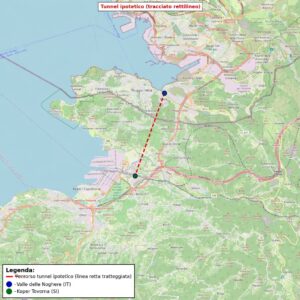
Proposed cross-border alignment: a 7-km railway tunnel designed to directly connect the Trieste Aquilinia rail junction (Noghere plain) with the Koper Tovorna freight yard (Sermin), linking the two port hinterlands underground.
The Physical Link: The Noghere Tunnel
This iron umbilical cord would break through the last remaining geopolitical barrier.
The central infrastructure would be an approximately seven-kilometre rail-only tunnel excavated through the flysch formations behind the coast.
Based on current cost parameters for major European railway engineering projects, the civil and technological works alone could be provisionally estimated at between €350 million and €500 million.
This is a substantial figure, but potentially sustainable if co-financed through European funds for the TEN-T corridors and amortised over the medium term through the logistics volumes generated by the project.
The establishment of a single Cross-Border Port Authority would allow the two sides to tackle jointly the dual structural bottleneck constraining the Slovenian port: its land-side yards are approaching physical exhaustion, while the historic railway connection towards the Karst is saturated.
Such an integrated infrastructure network would offer Koper’s container traffic an immediate logistical outlet, allowing Slovenian flows to be relieved directly through the extensive free-zone areas on the Trieste side.
It must nevertheless be emphasised that extending or making the customs-free regimes interoperable between the two sides would not follow automatically from the construction of a tunnel.
This is a complex legal matter requiring a specific international agreement and procedures fully compatible with European customs law — an issue that will be examined in detail in the second part of this dossier.
Conversely, trains originating in Trieste would gain direct access to the upgraded Koper–Divača corridor, exploiting the expansion of Slovenian railway infrastructure currently under way and opening an additional route towards the Central and Eastern European hinterland.
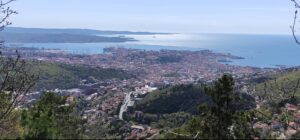
Operational cranes and rail connections: the essence of intermodal logistics in Trieste, ready for cross-border integration. Infrastructure designed to complete the logistical link with the Koper hub.
The Logistics City: Unlocking Untapped Capacity
Once the question of shared governance had been resolved, the unified logistics hinterland could integrate a series of areas that are already connected and capable of achieving the critical mass required for rapid storage and cargo distribution:
Hungarian Terminal (Former Aquila Refinery): 320,000 square metres of the former refinery site acquired by Budapest for the Adria Port project, designed to handle approximately two million tonnes of cargo per year by rail towards Central Europe.
Former Servola Steelworks Industrial Area: Approximately 600,000 square metres of converted industrial land — an area comparable in size to the entire Old Port — integrated with operational quays and rail connections capable of handling 740-metre block trains.
Navigable Canal and Zaule: The upgrading of the shunting tracks and the restoration of the industrial area’s rail network to allow trains to be routed directly onto the main railway corridor.
Noghere: The natural logistics hub positioned directly at the entrance to the proposed tunnel.
Prosecco Free Zone and Fernetti Intermodal Terminal: The high-ground relief hub for holding, reorganising and dispatching freight trains.
Cost-Benefit Analysis of the Customs-Free Regime in the Unified Port
Full implementation of the 1947 customs-free regime represents the real economic accelerator behind this scenario.
Principal benefits: Suspension of customs duties and VAT for as long as goods remain within the customs-free regime, combined with unlimited storage and the possibility of deferring payments for up to 180 days, would create a powerful competitive advantage in attracting logistics flows from Asia, Turkey and the Middle East.
The cross-border benefit would operate in both directions: Slovenian operators could gain access to Trieste’s customs advantages, while trains originating from the Trieste side could exploit the efficiency of the Slovenian rail network.
The potential employment impact is also significant, even when calculations are restricted solely to logistics and exclude manufacturing activities and offshore financial services.
One historical example is the International Financial and Insurance Centre envisaged by Article 6 of Italian Law No. 19/1991. Contemporary projections suggested that the scheme could attract as many as 450 foreign institutions to the Old Port under a preferential tax rate of 8.4 per cent.
The project remained frozen, however, after then EU Commissioner Mario Monti blocked its implementation in 1995, invoking incompatibility with Community law without ever providing a detailed specification of which European rules would prevent the project from operating.
Even without including such activities, an initial purely parametric simulation — which would have to be tested through an independent transport and economic study — suggests that a fully operational regime could produce a significant multiplier effect in terms of added value and skilled employment.
The beneficiaries would include logistics engineers, customs specialists, maritime-law professionals and automation technicians, offering a concrete response to the region’s demographic decline.
Costs and risks: The project would entail more complex controls to prevent abuse, significant environmental pressures on the territory and the postponement — or absence — of customs revenue for as long as goods remained within the customs-free regime.
These costs would have to be assessed against the additional revenues generated by services, employment and associated economic activity.
A binding bilateral agreement between Italy and Slovenia would also remain necessary to establish and manage the governance framework.
Taken as a whole, however, the potential benefits appear sufficient to justify an independent feasibility study, provided that the customs-free regime can be freed from the delays generated by national bureaucracy.
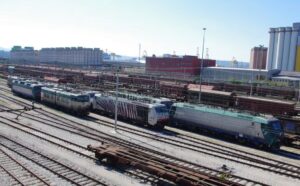
The Trieste Campo Marzio freight yard: the railway infrastructure that handles the onward movement and distribution of intermodal traffic towards the main European corridors.
The Architecture of Bottlenecks: Geopolitical Chokepoints and Control Valves
The ultimate constraint on the growth of an integrated system would remain the ability of states to control cargo flows through external infrastructure bottlenecks — without ever needing to violate international treaties.
The first bottleneck lies in Italy.
The coastal railway towards Monfalcone and the Bivio San Polo junction is a structurally saturated double-track route. A network operator would need only to extend maintenance periods or reduce the number of freight train paths available each hour to create congestion at Trieste Campo Marzio.
In Slovenia, the Divača junction remains under Ljubljana’s control. Trains arriving from the Trieste side could be slowed through restrictive technical inspections or changes to railway access charges.
Further north, Austria controls the corridors running from Tarvisio and Slovenia towards Vienna, Bavaria and the wider Central European markets. Night-time restrictions, limited capacity and the allocation of priority among different corridors could therefore affect the performance of the entire system.
On the road network, an initial purely parametric simulation — again requiring verification through an independent transport study — indicates that an exponential increase in truck traffic between Trieste and Koper would rapidly saturate Trieste’s main road network and the RA13 motorway connection.
It would also encounter the “metering” restrictions imposed at Alpine crossings and Slovenian motorway tolls.
Trieste’s physical geography compounds the problem: with very limited alternative road outlets, the network risks gridlock during severe weather or even following a relatively minor accident.
The Scale of the System
The two ports currently generate a combined total of approximately 110–130 trains per day.
Under a fully integrated and saturated scenario, a preliminary parametric simulation — to be tested through an independent transport study — suggests the following theoretical orders of magnitude:
| Logistics System Configuration | Theoretical Rail Capacity (Trains/Day) |
|---|---|
| Current Combined System | 110–130 |
| Upgraded Infrastructure, including Slovenia’s second track | 250–300 |
| Fully Developed Unified Super-Port — Former Aquila, Zaule, Noghere, Prosecco | 380–420 |
Such theoretical volumes would inevitably encounter the receiving capacity of the Austrian, Slovenian and German rail networks.
Without substantial expansion of the internal trans-Alpine corridors, congestion would simply migrate from the seaports to the mountains further north.
The Gulf’s Turning Point: Beyond the Wall
That continental bottleneck should not be regarded as a condemnation. On the contrary, it could become the territory’s greatest historical lever.
Pressure generated by growing cargo volumes would make the upgrading of Alpine crossings increasingly urgent, both economically and politically, anchoring the Upper Adriatic more firmly to the most productive regions of the European continent.
Beyond statistics and logistics flows, integrating the two ports into a single hub would also carry profound geopolitical and cultural significance.
It would begin to heal the historically artificial division between Trieste and its natural hinterland.
Although the Schengen system has already made that dividing line almost invisible, port integration would go one step further, bringing together — under a shared maritime and commercial vocation — the peoples of the Gulf, whose historical and social lives remained deeply intertwined until 1945.
Uniting the two ports and coordinating their infrastructure and customs regimes would offer a tangible opportunity for generational renewal.
For a city such as Trieste, confronted with persistent demographic decline and the departure of its younger skilled population, the development of advanced logistics represents an alternative to stagnation.
Integrating the Gulf’s two port lungs would restore the centrality of a macro-region that prospered for centuries precisely because of its role as a cross-border bridge.
An Adriatic Shenzhen is not a legal utopia.
It is the prospect of a territory once again capable of creating wealth, retaining its own human resources and reclaiming its role along the great trade routes of the European continent.
Note to the article — The 21 public authorities with responsibilities affecting the port system
Governance and Oversight:
(1) Ministry of Infrastructure and Transport;
(2) Port System Authority of the Eastern Adriatic Sea;
(3) Court of Auditors.
Taxation and Economic Security:
(4) Italian Customs and Monopolies Agency;
(5) Guardia di Finanza.
Public Order and Maritime Security:
(6) Harbour Master’s Office – Italian Coast Guard;
(7) Border Police;
(8) Maritime and Port Police Office of the Trieste Police Headquarters;
(9) Fire Brigade.
Health and Phytosanitary Controls:
(10) USMAF – Maritime Health Office;
(11) UVAC-PIF – Ministry of Health Border Inspection Post;
(12) Regional Phytosanitary Service.
Environment and Cultural Heritage:
(13) Ministry of the Environment and Energy Security;
(14) ARPA FVG – Regional Environmental Protection Agency of Friuli Venezia Giulia;
(15) Archaeology, Fine Arts and Landscape Superintendency of Friuli Venezia Giulia.
Employment and Social Security:
(16) ASUGI – Prevention and Safety Service;
(17) Territorial Labour Inspectorate;
(18) INPS – National Social Security Institute;
(19) INAIL – National Institute for Insurance against Accidents at Work.
Territorial Administration and Local Development:
(20) Municipality of Trieste;
(21) COSELAG – Consortium for Local Economic Development of the Giulian Area.
– Alessandro Gombač –
This page is also available in: Italian